
Turning Your Wedding Day Into a Story You’ll Want to Watch Forever
There are a lot of wedding videographers out there, and every videographer has their own personal style. I am by no means the final authority on what makes a wedding video good, but I do have some thoughts and preferences on how to make a wedding video special.
Videography has been my biggest passion for much of my life, and in recent years I’ve directed that passion towards the wedding industry.
But when I first started shooting weddings, there was a problem: I felt directionless. I didn’t have any kind of plan, or vision. Every wedding, I showed up, shot some clips, and then edited them together. I knew I could do better; I just didn’t have all the details figured out yet.
And then it hit me. I studied journalism and documentary filmmaking in college. In other words, I learned how to tell a real story, but to do it in a creative way. So I thought: why not do the same with wedding videos?
And that was when the wedding documentary first entered my mind. To be clear, I did not invent this style. But I have pondered it extensively, and truly believe it is the best style if you want your wedding video to be special, meaningful, and personal to you.
The “Problem” With Most Wedding Videos
I use the word “problem” with quotations because I don’t actually dislike the popular style of wedding video. I also don’t mean to be throwing shade at any other videographers. Everyone has their own approach, and every couple is looking for something different.
That being said, there was always something that bothered me about this style of wedding video, which I’m going to refer to as the “highlight video.” One day I ended up watching about a dozen different wedding highlight videos, and found that almost every one of them had the same characteristics that stood out to me:
Continuity
One thing I have often noticed in these videos is that the continuity is all out of order. A lot of highlight videos start with a shot of the couple walking hand in hand, smiling at one another. Then it might cut to a clip of someone reading their speech at the reception. And then it will cut to the morning, when both wedding parties are getting ready. In just the first 30 seconds, a lot of wedding videos will jump around the timeline of the day multiple times.
Again, there isn’t anything wrong with doing it this way, but it isn’t my personal style.
Structure
Or maybe I should say lack of structure. This goes hand-in-hand with the continuity issue. Because so many highlight videos jump around the timeline of the wedding day, there isn’t really any cohesive story structure.
Again, this isn’t a bad thing. It’s just how this style works. But for me, it conflicts with the natural way that I want to tell a story.
Posing
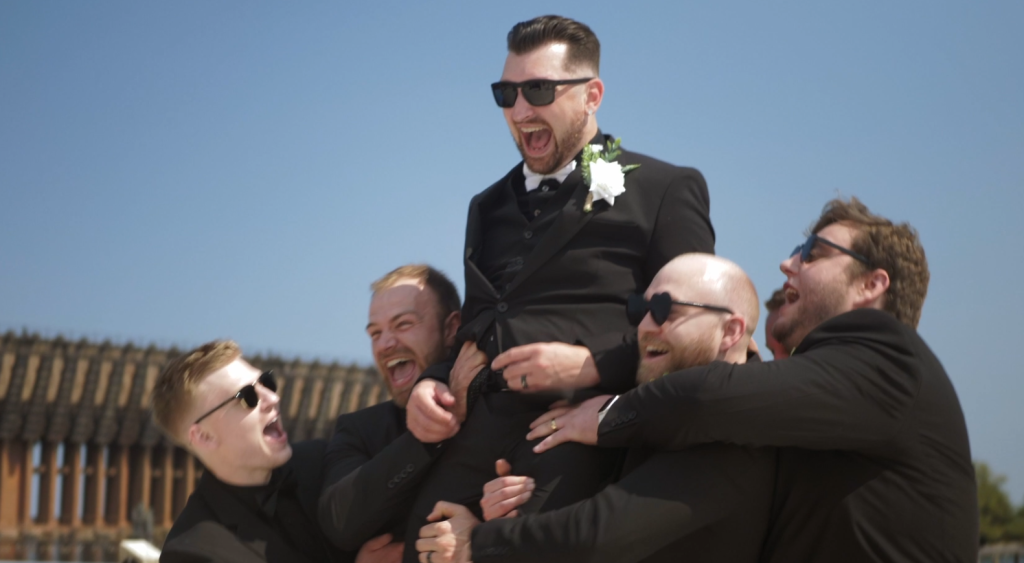
While I don’t think that there’s anything wrong with posed shots in a wedding video, and I use plenty of them myself, I do notice that a lot of wedding highlight videos tend to have a lot of posed shots. The problem that I have with poses is that they aren’t actually showing you a real moment; they’re showing you a pose. And it’s fine to show a couple poses here and there. But when I start to see too many of them, it ends up feeling more like a fashion shoot, or a music video than the story of someone’s wedding day.
Making Your Wedding Video Special
The wedding documentary is the solution to the issues I have with the traditional wedding video. A wedding documentary is just what it sounds like: a wedding video shot in the style of a documentary, with a focus on storytelling.
Again, I did not invent the wedding documentary, but I have spent the last few years ironing out my personal approach to it, and I want to dive into that approach here.
There are numerous elements that make a wedding documentary what it is:
Story Structure
Most people are familiar with the three-act story structure. Essentially, it’s a story told in three parts: the first act, which establishes the characters and the plot, the second act, which raises the stakes, and the third act, where everything comes to a head, and the story concludes.
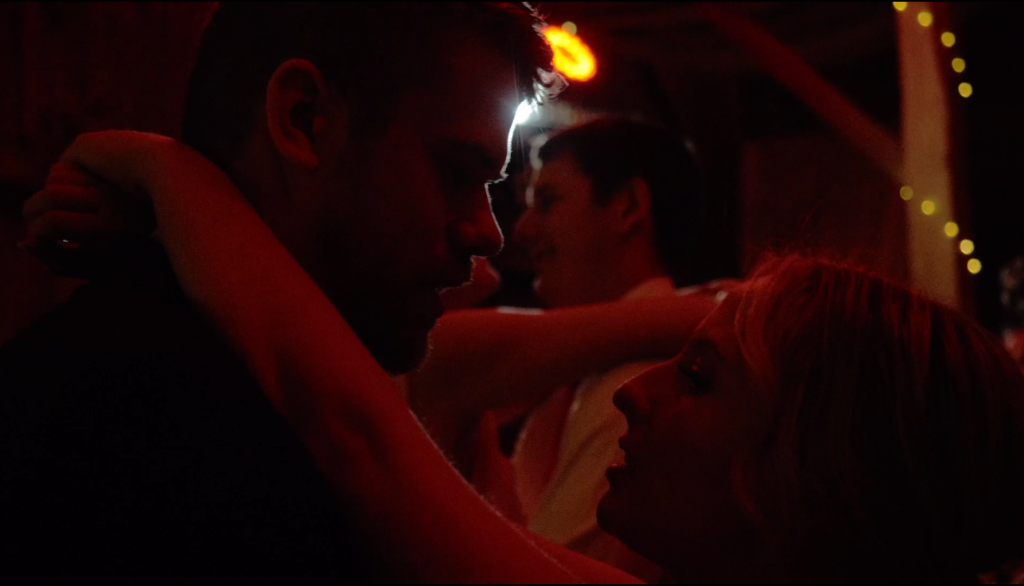
Conveniently, the typical wedding day has three distinct segments that can serve as the “acts” in our wedding video:
- Act 1: The morning preparations.
- Act 2: The ceremony.
- Act 3: The reception.
This is how I break down the structure of my wedding videos; I think about each part of the day as an act in the story.
I also mentioned in the previous section how a lot of modern wedding videos don’t follow any kind of continuity; that’s something I do differently for my wedding videos. My videos start at the beginning of the wedding day, and follow the events in chronological order. Personally, I feel this alone transforms it from a simple highlight video into a cohesive story.
Scenes
A documentary filmmaker who I look up to, Luc Forsyth, once said (and I’m paraphrasing here): videographers shoot clips, filmmakers shoot scenes.
That changed my whole perspective on how I shoot wedding videos. I realized that showing up and shooting a bunch of random clips of miscellaneous things isn’t going to help me tell a story.
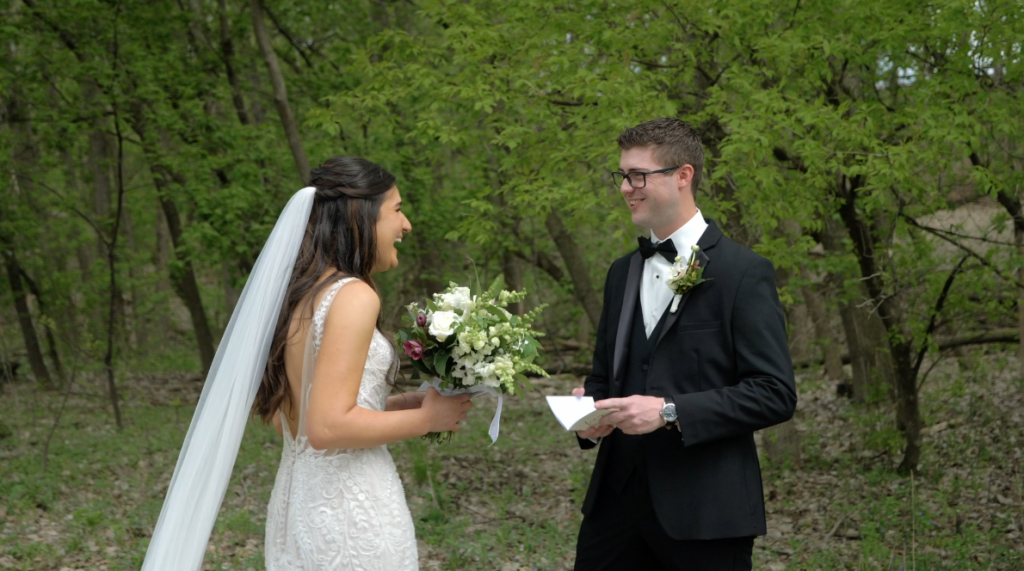
Instead, I need to think of my wedding videos in terms of scenes; each individual scene should introduce new information that moves the plot forward.
So now, when I arrive on a wedding day, I’m not just walking around with my camera and shooting randomly; I’m shooting clips that I know I will later construct into a scene that helps tell the story of that wedding.
Interviews
Interviews are a common aspect of any documentary, and they can be utilized in a wedding documentary as well.
To be clear, a wedding documentary doesn’t NEED to have interviews; you can have a perfectly good wedding video without them. However, interviews do add a lot of depth to the story, and I always recommend couples do them if they’re comfortable with it.
I love to interview my couples (separately) the morning of the wedding, and talk all about their relationship. I’ll ask them how they met, and how they fell in love. We’ll talk about any big moments from their relationship up to that point, and things they’re looking forward to on their wedding day.
I will then intersperse clips of these interviews throughout the wedding video. This gives more background on the couple’s relationship, and possible insight into what they might be feeling on their wedding day.
Less Posing
I mentioned above that a lot of wedding highlight videos tend to be riddled with posed shots. Again, this isn’t a bad thing, but it’s not my personal style.
The reason I prefer to keep posing to a minimum in a wedding video is because I don’t feel that those shots convey as much emotion or character. Now don’t get me wrong, I think posed shots can often be some of the most visually pleasing shots in a wedding video, which is why I’m always sure to get a good number of them at every wedding.
However, a wedding film isn’t just about looking good; it’s about capturing the emotions and memories of the wedding day, and that’s something that the poses just don’t do quite as well.
So, while the posing is not inherently a bad thing, I think an over reliance on posed shots can be.
Conclusion
A wedding video does have some inherent value just by nature of being a memento of your special day. However, I believe that putting more thought and intention into how it’s made can really make your wedding video special. I never want my videos to seem like I’m phoning it in, or just following a formula. I am passionate about storytelling, and I think that weddings are some of the best stories you can find in our day to day lives.